Do You Dream, or Do You Sleep? Building a Dream Layer for Oura Data
An n=1 experiment in sleep, dreams, and self-observation
I know it's not either/or. But across sleep tech, it feels like you either get a dream journal or a sleep tracker — never both.
I've always been fascinated by sleep, and even more by dreaming. We spend a third of our lives in this state. When you remember your dreams, you can have some incredible adventures — but if you're going through something difficult, that shows up too. Just because we don't always remember our dreams doesn't mean they didn't happen, or that they aren't shaping our sleep quality.
I've used Oura since 2019, and dreaming has always felt like the one piece of data slipping through the cracks. I'm curious how my waking life and my dreaming life interact — what that means for my stress, my health, my actual sleep quality, not just the score Oura gives me in the morning.
So I went on a research deep dive with Perplexity, and found some genuinely interesting territory. On one end, DreamBank — a public archive built by researchers Domhoff and Schneider containing over 22,000 dream reports, used for decades to study what we actually dream about and how consistent it is over time. On the other end, something more tangled: a body of research on nightmares and next-morning cortisol that doesn't point in one clean direction (more on that below).
That was enough to convince me this wasn't just a curiosity. So I built my own n=1 experiment.
The premise
This is a personal experiment — just me — that adds a structured dream journal on top of my Oura Ring data. Not to interpret dreams as medical evidence, and definitely not to claim a wearable can diagnose anything. Just to put subjective dream experience next to longitudinal sleep and recovery data and see what repeats.
The question I keep coming back to:
What changes in my sleep and recovery data tend to show up on nights when I remember a dream, have an emotionally intense one, dream something recurring, or wake from a nightmare?
Right now it's personal and private by design. Before I think about anyone else using it, I want to know whether logging dreams alongside Oura data is actually useful, sustainable, and analytically interesting for one person — me.
Why this is worth testing
Dream recall isn't random. Sleep research consistently finds people report dreams more often when woken from REM than from NREM sleep. But dreaming isn't exclusive to REM, and remembering one depends on when you wake, how fast you write it down, how interested you are in dreams, and stable differences in memory and attention from person to person.
That makes this a good personal question, not a deterministic one. The tool isn't asking whether REM caused a dream. It's asking whether, across a consistent personal dataset, dream-recall nights tend to look different — REM profile, sleep efficiency, disturbance pattern, recovery signal — than nights with no remembered dream.
Oura is a good fit for this because it gives nightly estimates across all of those. But it's worth being honest about the limits: a consumer wearable is not a sleep lab. Oura is valuable for spotting trends within one person over time — its sleep-stage labels are estimates, not a direct read of brain activity the way polysomnography is. That's exactly why the journal matters. It adds a layer the wearable can't capture on its own.
What the journal captures
Built to be fast enough to fill out right after waking, when dream memory is most available:
Dream recall (yes/no)
Overall tone (positive, neutral, negative)
Whether a negative dream woke me up
Nightmare flag
Feelings, multi-select (happy, excited, sad, stressed/anxious, angry, confused, calm)
Dream count
Recurring dream, plus an optional label to link repeats over time
Optional free-text narrative
The emotion tags are multi-select on purpose — dreams are often mixed (stressful and exciting, sad and peaceful), and a single-choice system would flatten that.
Negative dreams vs. nightmares
A negative dream isn't automatically a nightmare. Here, a negative dream is anything upsetting, stressful, sad, threatening, or uncomfortable. A nightmare is a negative dream that wakes me up. One nightmare doesn't imply nightmare disorder, which requires recurring nightmares causing real distress or impairment.
That distinction lets me compare negative dreams against neutral/positive ones, nightmares against non-nightmares, and negative dreams that caused waking against ones that didn't — which should help separate emotional dream tone from actual sleep disruption.
Turning reflection into data
The optional free-text entry does two things: it keeps the actual narrative, and it makes theme analysis possible. An AI layer pulls consistent categories out of it — family, work, relationships, health, money, travel, home, conflict, school, or unknown/abstract — inspired by the Hall–Van de Castle system, one of the best-known frameworks for coding dream reports into structured data (the same tradition DreamBank grew out of). This is a lighter version — enough structure to analyze, not so much that logging becomes a chore.
The Oura layer
The dream log joins to nightly Oura data on the sleep date. What I'm pulling in:
Category | Variables |
Sleep structure | REM, deep, light minutes, total duration |
Sleep continuity | Efficiency, latency, disturbances, wake periods |
Cardiovascular recovery | Heart rate, resting HR, HRV |
Oura scores | Sleep Score, Readiness |
Physiological context | Temperature deviation, respiratory rate (when available) |
Oura connects via API inside Lovable — a manual Sync pulls the latest nightly records into Supabase. Automating that is a next step, not a today problem.
Why HRV, specifically
The autonomic nervous system shifts across sleep stages — REM has a more variable cardiovascular profile than stable NREM, and research on people with recurrent nightmares has found REM-related differences in cardiac variability. That doesn't mean HRV can detect a dream or flag a nightmare — HRV moves for a dozen reasons (stress, illness, exercise, alcohol, meds, cycle changes, overall recovery). Here it's a context signal.
The research on nightmares and next-morning stress physiology is more tangled than a single clean finding, which honestly makes it more interesting. One study found an acute nightmare triggers an elevated cortisol awakening response (CAR) the next morning, alongside worse next-day mood, health, and sleep quality, compared to nights with a neutral dream. But a separate study of women with chronically frequent nightmares found the opposite direction — a blunted CAR — suggesting habituation or kicks in with chronic frequency, distinct from what happens after a single bad night. A more recent 2026 conference abstract found CAR significantly correlated with nightmare presence in college students (r = 0.35), reinforcing that morning cortisol reactivity is a meaningful marker even though the direction of causality is still unresolved.
Oura doesn't measure cortisol directly, so I can't chase that signal exactly — this would need a separate biosample or a proxy like resting heart rate elevation or temperature deviation. But it's the reason HRV earns a place in this dataset at all: it's the closest thing Oura can offer to a same-day echo of that stress response.
Early hypotheses
Hypothesis | Dream-layer signal | Oura comparison |
Recall may differ by sleep architecture | Recall (y/n) | REM min/%, total sleep, efficiency |
More dreams may mean more recall opportunity or disruption | Dream count | REM min, disturbances, wake time |
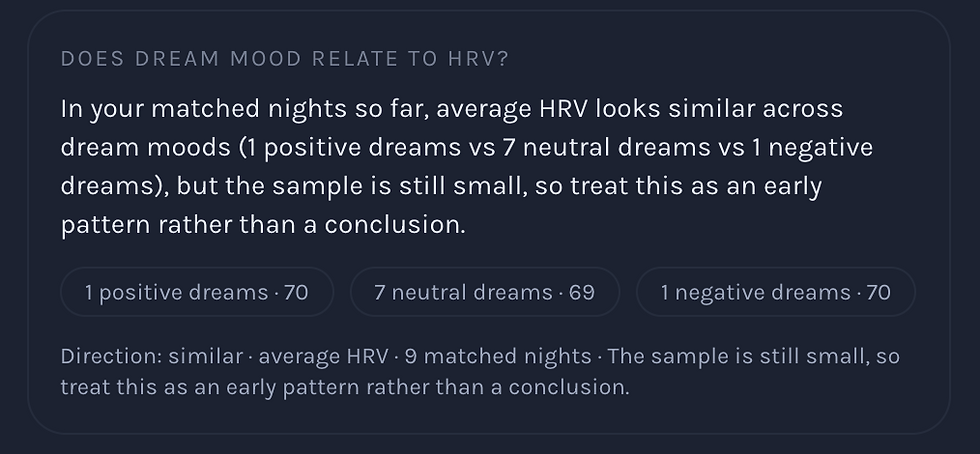
Emotional tone may co-occur with recovery state | Feelings, valence | HRV, HR, Sleep Score |
Nightmares may track with interruption | Negative + awakening | Disturbances, efficiency, next-day Readiness |
Recurring dreams may cluster in life periods | Recurring label, theme | Sleep duration, HRV, temp deviation over time |
Themes may reveal patterns scores miss | Work/family/relationship/health/conflict tags | Continuity and recovery trends |
How I'm analyzing it
Deliberately exploratory, and within-person — a heavy dream recaller and a light one probably have very different baselines, so pooling too early would bury the signal. First views: recall vs. no-recall, nightmare vs. everything else, positive/neutral/negative tone, individual feeling tags against HRV/HR/efficiency/REM, recurring themes over time, dream events against next-morning Readiness. For continuous metrics I'll lean on non-parametric correlations (Spearman); for binary ones (recall, nightmare, recurrence) I'll compare group averages now and consider simple logistic models once there's enough data.
The rule that governs all of it: any pattern here is a correlation, not proof. A stressful week could lower HRV, fragment sleep, shift dream emotion, and boost recall all at once — the dream doesn't need to cause the HRV change, and vice versa. Both could just be downstream of the same week.
Guardrails
Correlation isn't causation.
No recall ≠ no dreaming — it just means nothing was remembered.
Oura's sleep stages are estimates, useful for personal trends, not lab-grade measurement.
A "nightmare" tag is a data label, not a diagnosis.
One night means almost nothing. The value is in the accumulation.
None of this is medical advice, and it diagnoses nothing.
The point was never to turn dreams into a score. It's to give dream experience a seat at the table next to the sleep and recovery data we already collect.


What's next
Right now it's a one-person tool: log a dream, attach it to the prior night's sleep date, pull in Oura data, store it all in one structure, build simple comparison views, and keep collecting matched nights before drawing any real conclusions.
Beyond my own little self-awareness experiment, though, I keep thinking about the wider version. A wide-net analysis of dreams across many Oura users could reveal something none of us could see alone — how dreaming interacts with HRV, recovery, even mental health, at a scale a single n=1 journal never could.
Research sources
Domhoff, G. W. & Schneider, A. (2008). Studying dream content using the archive and search engine on DreamBank.net. Consciousness and Cognition.
Elce, V. et al. (2025). The individual determinants of morning dream recall. Communications Psychology.
Stucky, B. et al. (2025). We are the Sensors of Consciousness! A Review and Analysis on How Awakenings During Sleep Influence Dream Recall. Nature and Science of Sleep.
Chouchou, F. & Desseilles, M. (2014). Heart rate variability: a tool to explore the sleeping brain? Frontiers in Neuroscience.
Nielsen, T. et al. (2010). Changes in cardiac variability after REM sleep deprivation in recurrent nightmares. Sleep.
Németh, D. et al. (2012). Altered sleep architecture in subjects with frequent nightmares. Sleep and Biological Rhythms.
Hasler, B. & Germain, A. (2009). Correlates and Treatments of Nightmares in Adults. Sleep Medicine Clinics.
Hess, G., Schredl, M., Gierens, A., & Domes, G. (2020). Effects of nightmares on the cortisol awakening response: An ambulatory assessment pilot study. Psychoneuroendocrinology.
Nagy, T. et al. (2015). Frequent nightmares are associated with blunted cortisol awakening response in women. Biological Psychology.
(2026). Cortisol Awakening Response Predicts Nightmares in College Students: Evidence for Stress-Physiology Sensitivity in Disturbed Dreaming. SLEEP (conference abstract).
Fogli, A. et al. (2020). Our dreams, our selves: automatic analysis of dream reports. Royal Society Open Science.
Hall, C. S. & Van de Castle, R. L. Coding Rules for the Hall/Van de Castle System of Quantitative Dream Content Analysis.
de Zambotti, M. et al. (2018). The Sleep of the Ring: Comparison of the ŌURA Sleep Tracker Against Polysomnography. Behavioral Sleep Medicine.
Nagele, A. N. et al. (2024). "The sleep data looks way better than I feel": An autoethnographic investigation of sleep tracking with an Oura Ring. Frontiers in Computer Science.
Zhang, J. et al. (2024). Evidence of an active role of dreaming in emotional memory processing. Scientific Reports.
Scarpelli, S. et al. (2019). The Functional Role of Dreaming in Emotional Processes. Frontiers in Psychology.
This is an exploratory self-study. These sources informed the experiment's design and hypotheses — they don't establish that Oura metrics can diagnose dreams, health conditions, or sleep disorders.


Comments